


The Emirates of Africa: How Ethiopia Plans to Fly Africans
By: Pawan Kumar, Financial & Economic Journalist

The Emirates of Africa: How Ethiopia Plans to Fly Africans
Why am I writing about Ethiopia today? Because the country has just doubled down on a decades-long bet: that Africa’s aviation future will be routed through Addis Ababa.
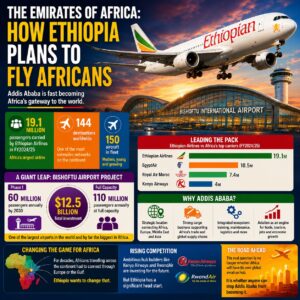
The numbers are telling. Ethiopian Airlines carried 19.1 million passengers in FY2024/25, making it Africa’s largest airline by passenger traffic.
Compare that with EgyptAir’s roughly 10.5 million passengers, Royal Air Maroc’s 7.4 million and Kenya Airways’ around 4 million. Even among Africa’s best-known flag carriers- South African Airways, Kenya Airways, EgyptAir and Royal Air Maroc-Ethiopian now operates on a completely different scale.

Now comes the next leap. Ethiopia has launched the $12.5 billion Bishoftu International Airport project near Addis Ababa. The first phase is expected to handle 60 million passengers annually by 2030, while the fully developed hub is designed for 110 million passengers a year-making it one of the largest airports in the world and by far the biggest in Africa.
This is not merely an airport expansion. It is a long-term economic strategy. Aviation is increasingly viewed as an engine for trade, tourism, logistics, manufacturing and foreign investment. Countries that become global transit hubs rarely earn only from airline tickets–they generate value through cargo, maintenance services, hospitality, financial services, airport retail and business travel. Ethiopia is betting that aviation can become a cornerstone of its broader economic transformation.
The timing is significant. Africa remains one of the world’s fastest-growing aviation markets, yet it is also among the least connected. Intra-African air travel accounts for a relatively small share of total traffic, and many passengers flying between African cities still transit through hubs in Europe or the Gulf. That adds travel time, increases costs and reflects the continent’s fragmented aviation market. Addis Ababa aims to bridge that gap by becoming Africa’s primary connecting hub.
Ethiopian Airlines already operates a fleet of around 150 aircraft and serves 144 destinations worldwide, including one of the most extensive networks across Africa. Unlike many state-owned airlines that have struggled financially, Ethiopian has built a reputation for operational discipline, fleet modernisation and network expansion. It has also invested in pilot training, aircraft maintenance and cargo operations, creating an integrated aviation ecosystem rather than relying solely on passenger traffic.
Cargo deserves particular attention. As global supply chains diversify and African exports expand—from fresh produce and pharmaceuticals to textiles and high-value manufacturing–air freight is becoming a strategic business. Ethiopian Airlines has already emerged as one of Africa’s largest cargo operators, giving it an advantage that extends well beyond passenger travel.
Geography is another competitive advantage. Addis Ababa sits at a strategic crossroads between Africa, Europe, the Middle East and Asia, allowing airlines to efficiently connect passengers and cargo across multiple regions. It is a position similar to the one Dubai successfully leveraged over the past three decades to build Emirates into one of the world’s leading international airlines.
The more interesting competition may come from ambitious hub builders such as Kenya Airways, RwandAir and, over time, Nigeria as it seeks to strengthen its aviation sector. Beyond Africa, Gulf carriers—including Emirates, Qatar Airways and Etihad–will continue competing aggressively for transit passengers travelling between Africa, Europe and Asia. The battle is therefore not just for African skies, but for global connecting traffic.
For India, Ethiopia’s rise is worth watching closely. Indian airlines are expanding internationally, and Africa is increasingly viewed as a promising growth market for trade, investment and passenger traffic. A stronger Addis Ababa hub could reshape travel patterns for Indian businesses, tourists and exporters while opening new opportunities for connectivity between South Asia and Africa.
But for now, Ethiopia enjoys a significant head start. The real question is no longer whether Africa will have its own global aviation hub.
It is whether anyone can stop Addis Ababa from becoming it.
(The author is a renowned financial journalist, an avid traveller and a part time musician. Views expressed are his own)
















Leave a comment